Apoorav Khela: The Poet History Forgot and the Forests Remember
There is no biography of Anandghan. There is no portrait. There is no monastic record that says: on this date, in this place, this man was born. The 17th-century Jain saint-poet exists almost entirely through his poetry and through the anecdotes that have been passed down, mouth to mouth, across four hundred years. His childhood name was Labhanand. He was initiated as a Svetambara monk in the Tapa Gaccha order under the name Labhavijaya. Scholars estimate he was born before 1624, possibly in Rajputana, and died before 1694, possibly in Medata, Rajasthan, where a hall is dedicated to his memory. Everything else is inference, legend, and song.
His name means ‘cloud of bliss.’ Anand: joy. Ghan: mass, density, cloud. The name is not a metaphor. It is a description. The oral traditions describe a man whose proximity to nature pacified beasts in the forests and made trees sway in gardens. He was an avdhoot — an ascetic who had renounced not just worldly attachments but the formal structures of monasticism itself. His absence from the Tapa Gaccha’s official records suggests he was always an outsider, always moving, always beyond the institution’s reach.
What he left behind was poetry of extraordinary power. His padas — devotional songs composed in a mixed vernacular of Gujarati, Rajasthani, and Braj — are still sung in Jain temples across India. They appear in Svetambara collections and Digambara collections alike, crossing the sectarian divide that separates Jainism’s two major traditions — a feat almost no other Jain poet has achieved. His Anandghan Chauvisi comprises hymns to the twenty-four Jain Tirthankaras. His Anandghan Bahattari, an anthology formalised by 1775, was transmitted orally alongside the verses of Kabir, Surdas, and Banarasidas. Mahatma Gandhi included one of his hymns in his personal prayer collection. The scholar Yashovijaya is said to have memorised Anandghan’s compositions at Mount Abu.
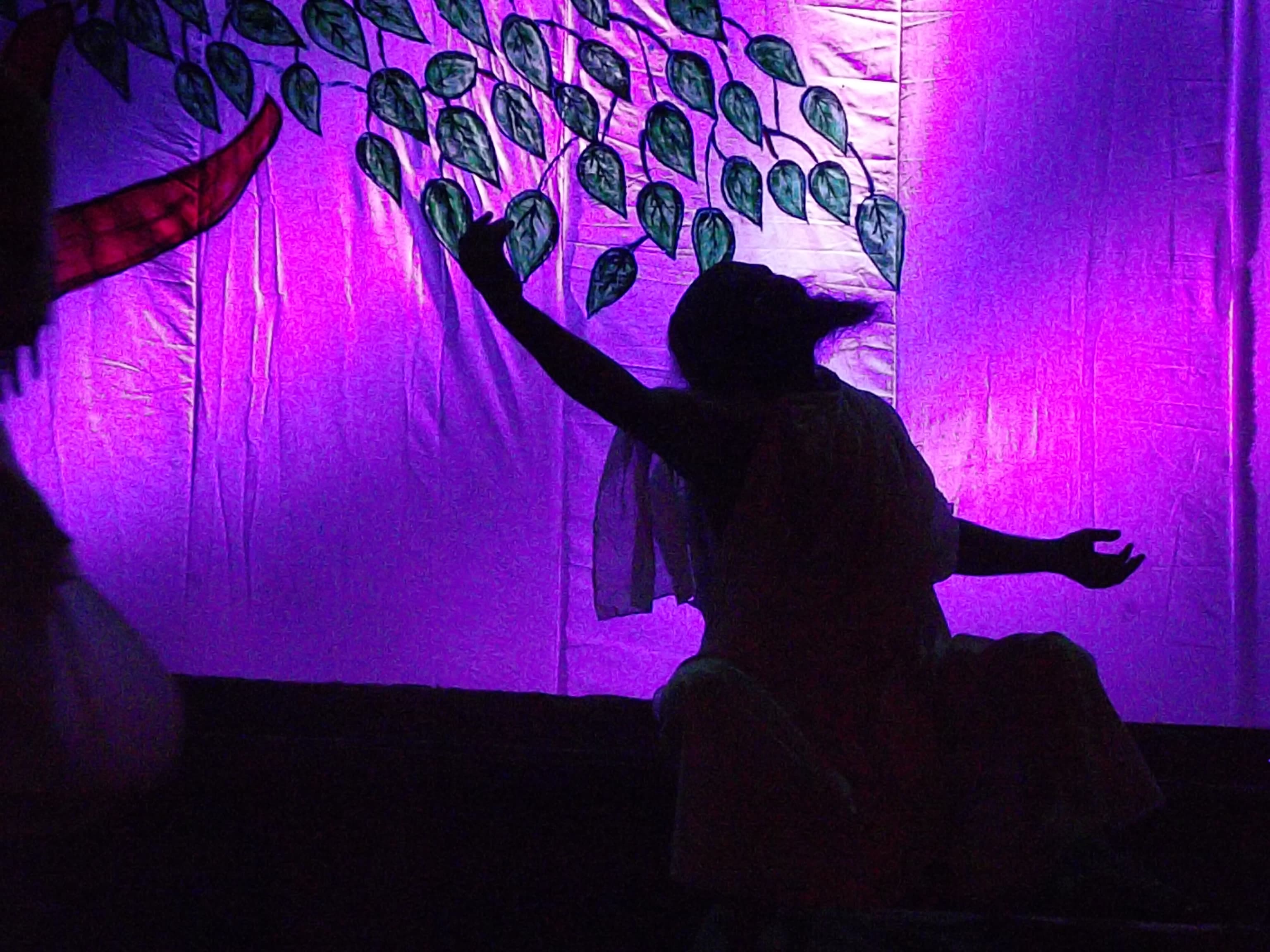
This is the man Manoj Shah decided to put on stage. The challenge was, as film theorist Amrit Gangar wrote in his 2012 essay on Shah’s Jain plays, ‘the biggest’ of all four productions: ‘enlivening the character of Anandghan about whom barely any information is available.’ How do you dramatise a life that left no autobiography, no letters, no documented dates?
The answer came from Dr. Dhanvant Shah, who wrote the script by weaving together the oral traditions, the legends, and the padas themselves. The play does not attempt a conventional biography. It cannot. Instead, it constructs a world from fragments: the anecdotes that surround the saint, the spiritual compositions that survive him, the Rajasthani landscape he wandered. Five actors — Ashok Parmar, Jay Upadhyay, Nimesh Dave, Manish Rohit, and Sagar Rawal — inhabit a stage designed by Kabir Thakore, the Ahmedabad architect whose work for Ideas Unlimited has shaped productions from Bhav Prapanch to Kaagdo.
Uday Mazumdar’s music is central. Anandghan was a poet who sang. His padas were not composed for reading but for performance — spontaneous, ecstatic, inseparable from melody. Mazumdar’s score gives the play its folk texture, its Rajasthani soul. Rajesh Mandloi worked on the dialect to ensure the language carried the weight of the desert and the devotion. Rajiv Bhatt’s costumes and Pritesh Sodha’s lighting complete a production that is less narrative than experience.
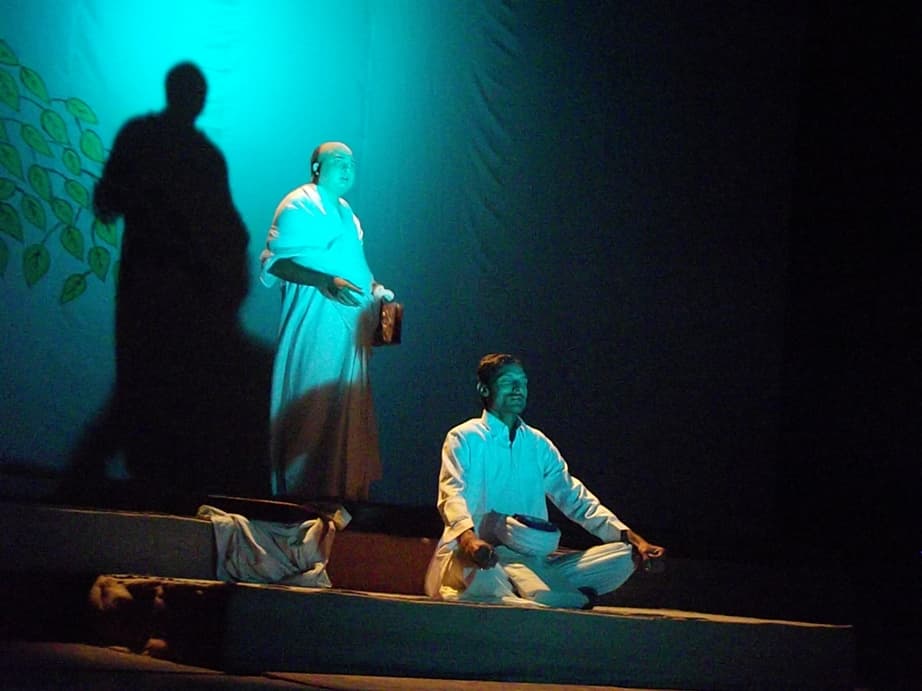
Apoorav Khela was the fourth in what Amrit Gangar identified as Shah’s Jain tetralogy: Apurva Avsar (Shrimad Rajchandra, 2007), Vastupal Tejpal (the builders of the Dilwara Temple, 2008), Siddhahem (Acharya Hemchandracharya, 2010), and Apoorav Khela (2012). Together they constitute what Gangar called ‘perhaps the first time in the history of Gujarati theatre’ that ‘such a strong body of work articulates Jainism through proscenium theatre in its different facets.’
What makes Anandghan significant — and what the play foregrounds — is his radical universalism. Gangar’s essay puts it precisely: ‘He is a cliché-breaker, he is the one who could cross boundaries and accept religious wisdoms from anywhere else, he is the one who is against narrow and parochial sectism, he is the one who could embrace poetry and music so easily and with lightness of being.’ In a tradition often associated with austerity and renunciation, Anandghan represents something rarer: joy. His very name insists on it.
The play’s programme notes describe it as ‘an astonishing flight of happiness, to take the audience on a trip which begins with anand and ends with Anandghan.’ It is a play about a man who could not be held — not by institutions, not by sectarian boundaries, not by history’s desire to categorise and record. He moved through the forests of Rajasthan singing to no audience but the trees, and four centuries later his songs are still sung by millions who have never heard his name.
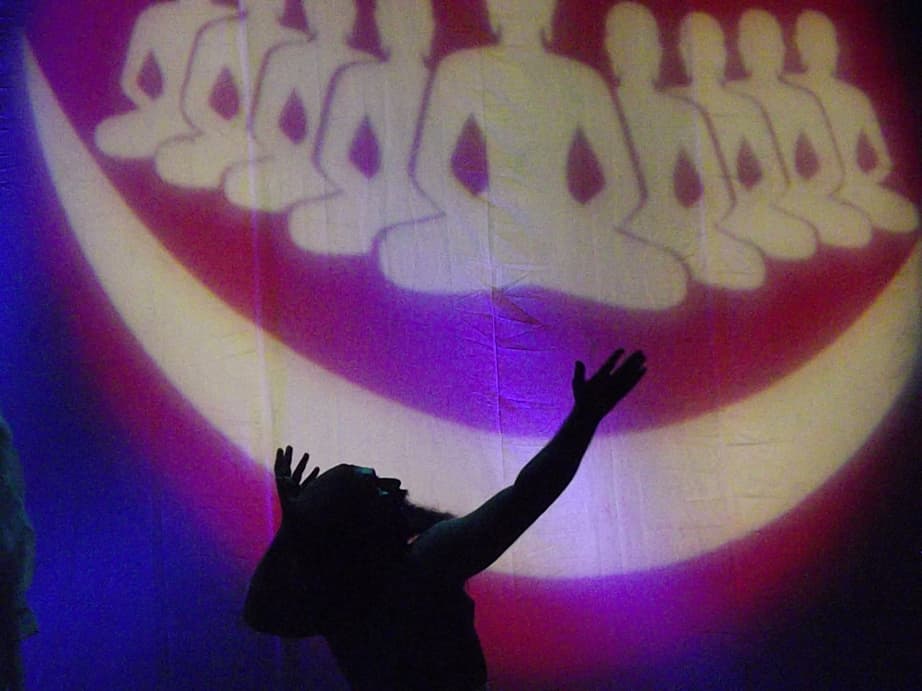
The title Apoorav Khela means ‘a wondrous play.’ It is both the name of the production and a description of what Anandghan’s life was: a performance so rare, so unprecedented, that it could only be experienced, never fully explained. As the play’s own synopsis puts it: one cannot hold air, stop water from flowing, stop the sun from rising. One only experiences it. In the same way, one cannot talk about Apoorav Khela. Only experience it.
.JPG&w=3840&q=75)